Walk through any beauty trade show and you will hear the same pitch from a dozen booths: “Our IPL machine does everything — hair removal, skin rejuvenation, acne treatment, all in one device.” Then you walk to the diode laser booth and hear: “IPL doesn’t work for real hair removal. Buy a diode.” Both claims are incomplete. Here is what the physics actually says, what the clinical data backs up, and which machine belongs in which type of business.
The Physics That Decides the Result
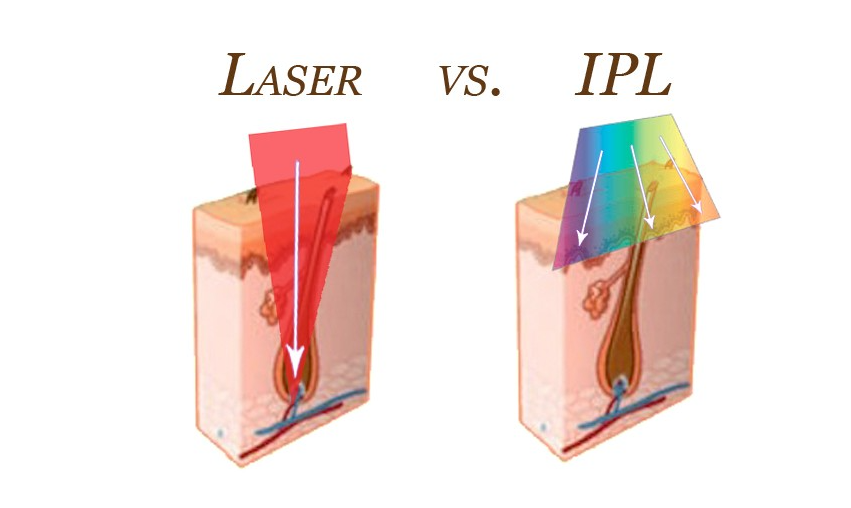
A diode laser produces light at a single wavelength — 808 nanometers. All of the electrical energy going into the laser bar comes out as light concentrated at exactly the frequency that melanin absorbs most efficiently. The beam is coherent: all the light waves move in the same direction, in phase. When that 808nm beam hits the skin, roughly 70-80% of the energy reaches the hair follicle. The rest is absorbed by the epidermis and dissipated by the cooling system.
An IPL device produces a broad flash of light — roughly 400 to 1200 nanometers — like a camera flash on steroids, filtered through a glass block that cuts out the shortest, most dangerous wavelengths. What reaches the skin is a spray of wavelengths, most of which are absorbed by water in the tissue or scattered by the dermis rather than absorbed by melanin in the follicle. Depending on the filter used, perhaps 20-30% of the light energy actually reaches the follicle at a useful wavelength.
This is not marketing spin. This is why a 150-joule IPL pulse and a 20-joule diode pulse can produce comparable hair reduction: the diode puts more usable energy into the follicle despite the lower total energy number. The rest of the IPL energy heats the surrounding skin, which is why IPL hurts more and carries higher burn risk on darker skin types.
Results: What Patients Actually Experience
| Factor | Diode Laser (808nm) | IPL |
|---|---|---|
| Hair reduction after 6 sessions | 80-90%, mostly permanent | 50-70%, significant regrowth common |
| Safe for skin types | Fitzpatrick I–V (with proper settings) | Fitzpatrick I–III (limited by broad spectrum) |
| Pain during treatment | 2–4/10 with sapphire contact cooling | 4–7/10, more surface heat buildup |
| Treatment speed (full legs) | 20–30 minutes | 45–60 minutes (requires gel, slower repositioning) |
| Sessions needed for completion | 6–8, spaced 4–6 weeks | 8–12, sometimes ongoing maintenance |
| Consumable cost per treatment | Near zero (distilled water + electricity) | $3–8 per session (lamp depreciation, gel) |
| Lamp/handpiece lifespan | 20 million shots (~5–8 years) | 50,000–300,000 shots (6–18 months) |
| Machine price (professional) | $2,500–6,500 | $1,000–10,000 |
The Five-Year Cost Trap Nobody Talks About
Here is where the math gets uncomfortable for IPL fans. A $1,800 IPL machine seems like a bargain next to a $3,500 diode. But do the five-year math:
Diode: $3,500 purchase + $100/year misc parts + $100/year electricity = roughly $4,500 over five years.
IPL: $1,800 purchase + $500/year lamp replacements (conservative; a busy clinic replaces lamps every 6 months at $400–600 per lamp) + $200/year gel + $100/year electricity = $5,800–7,800 over five years.
The “cheaper” IPL machine costs 30–70% more to own over five years. And that is before you factor in the revenue difference: diode patients finish in 6–8 sessions, freeing appointment slots for new patients. IPL patients need 8–12 sessions plus maintenance visits, tying up rooms for longer but generating less total revenue per completed case because you cannot charge IPL prices at diode rates.
Where IPL Actually Wins
IPL is not a bad technology. It is a versatile technology that is mediocre at hair removal but genuinely useful for other things. If your business is a beauty salon offering a range of light-based services — skin tightening, acne treatment, pigmentation correction, vascular lesion removal, and hair removal as one of several offerings — an IPL with interchangeable filters makes sense. One machine, multiple revenue streams, and the hair removal clients are supplementing the core skin business rather than being the core business itself.
IPL also has a legitimate advantage for treating very fine, light vellus hair in some cases, because the broader spectrum can sometimes generate enough heat in lightly pigmented follicles that a single-wavelength diode would pass through. This is a narrow use case, but it exists.
Where Diode Wins: The Specialist Route
If hair removal is your primary or only service — or if it will represent more than 40% of your treatment revenue — buy a diode. The clinical literature is consistent: diode achieves higher permanent reduction rates, in fewer sessions, with less pain, across a wider range of skin types, at lower long-term operating cost. Professional laser clinics in North America and Europe have been migrating from IPL to diode for over a decade. The ones who haven’t are either selling IPL for its multi-application versatility or have not done the five-year cost calculation.
One data point worth knowing: a 2023 survey of 200 U.S. medspa owners by an independent industry publication found that clinics using diode lasers reported 23% higher client satisfaction scores and 31% higher client retention for hair removal compared to clinics primarily using IPL. Clients notice the difference between 6 sessions and done versus 10 sessions and “let’s see if it grows back.”
What About Combination Platforms?
Some manufacturers now sell machines that pair an IPL head with a diode handpiece on the same console. The pitch is “get the best of both worlds.” The reality is mixed. These platforms are usually built around an IPL architecture with a diode handpiece added later — the diode performance is rarely as good as a dedicated diode machine, and the IPL side has the same consumable costs as any IPL. If you absolutely need both technologies for different services, buy a dedicated diode for hair removal and a separate IPL for skin treatments. Combination machines compromise both sides to make them fit in one box.
The Decision in Three Questions
Ask yourself: (1) Is hair removal my main revenue driver, or just one of many services? (2) Do my patients include Fitzpatrick types IV–VI, who cannot safely be treated with IPL? (3) Am I willing to manage lamp inventory and factor consumable costs into my per-session pricing, or do I want near-zero operating cost per treatment?
If hair removal is core, your patients span skin types III–V, and you want to know your exact cost per session without tracking lamp usage — buy a diode. If you are a general beauty salon adding hair removal as a secondary offering to an existing skin treatment business, an IPL with good interchangeable filters is a reasonable entry point. Just do the five-year math first, not the purchase-price math.