If you’ve spent any time Googling “best diode laser machine,” you already know the problem.
Every listicle says the same thing. Top 10 machines. Five stars. “Best in class.” Half of them are written by people who’ve never touched a laser handpiece in their lives. The other half are affiliate link farms that make money when you click, not when your clinic succeeds.
I sell these machines for a living. And I’m going to tell you something that might sound strange coming from someone who sells these machines for a living.
There is no single “best” diode laser machine.
There’s the best machine for your situation. Your patient volume. Your skin-type mix. Your budget. Your growth plan.
This guide is about helping you find that machine. Not the one someone paid to rank first.
First, Let’s Kill the Biggest Myth
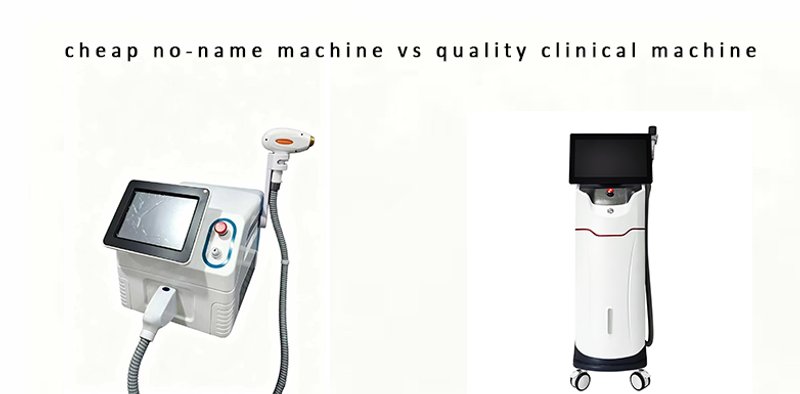
“Higher wattage = better results.”
Not exactly.
A 3000W machine treats a full body in about 18 minutes. A 600W machine takes closer to 35. That’s a real difference. But here’s what the spec sheet won’t tell you: if you’re doing 5 patients a day, you don’t need 3000 watts. You’ll never use it. You’re paying for horsepower that sits idle.
And wattage has almost nothing to do with treatment effectiveness. A 600W machine at the right fluence will destroy a hair follicle just as permanently as a 3000W machine. It’ll just take a few more pulses to cover the same area.
So before you look at any spec, answer one question: how many patients do you realistically treat per day?
That answer determines everything else.
In This Guide
The Four Decisions That Actually Matter
Forget the marketing fluff. When I help clinics choose a machine, we work through exactly four decisions. Everything else is noise.
Decision 1: What’s Your Patient Volume?
Here’s my honest take, based on watching hundreds of clinics operate.
5-8 patients per day. A 600W machine is plenty. You’ll finish each treatment in 30-40 minutes. Your machine will have plenty of idle time between patients. Spending more on higher power is money you won’t recoup through faster throughput because you don’t have the patient flow to fill the extra capacity.
10-15 patients per day. Now we’re talking 1200W to 1600W territory. At this volume, the faster repetition rate (10 Hz vs 6 Hz) actually matters. Going from 30 minutes to 20 minutes per patient buys you 1-2 extra appointment slots per day. That’s $100-200 more daily revenue.
20+ patients per day. You need 2000W minimum, preferably 3000W. At this volume, every saved minute per treatment is real money. A 3000W machine with a 15×25mm large spot treats a full back in 12 minutes vs 35 on a 600W. That’s not a luxury — it’s capacity you’ll use every single day.
One clinic I work with in Dubai does 28 patients daily on two 3000W machines. They tried running a 1200W as a backup unit once. It created a bottleneck within two hours. Match the machine to the volume.
Decision 2: What Skin Types Do You Serve?
| Fitzpatrick | Skin Tone | Best Wavelength | Recommended Machine | Notes |
|---|---|---|---|---|
| I-II | Very fair, fair | 808nm | Single-wave 808nm | 755nm option for fine hair |
| III-IV | Medium, olive, light brown | 808nm+1064nm | Triple Wavelength | 808nm daily, 1064nm safety |
| V | Brown, dark brown | 1064nm primary | Triple Wave 1600W | Bypasses melanin |
| VI | Very dark | 1064nm only | 4-Wavelength Flagship | 940nm for deep hair |
This one is simpler than most people make it.
80%+ of your clients are Fitzpatrick I-III (fair to medium). A single-wavelength 808nm machine is all you need. You’ll treat effectively. You’ll be safe. You’ll save $1,000-2,000 vs a multi-wavelength system.
You serve a mixed population — fair to dark skin across Fitzpatrick I-V. Get a triple-wavelength system (755+808+1064nm). The 755nm handles fine hair on fair skin. The 808nm is your daily workhorse. The 1064nm makes dark skin safe to treat. This setup covers roughly 95% of the patients you’ll ever see.
You’re in a diverse metro area, or you want zero skin-type limitations. The four-wavelength system (755+808+940+1064nm) covers everyone. The 940nm penetrates deeper than 808nm — useful for stubborn terminal hair on male clients and PCOS patients. It’s a niche advantage, but if you market yourself as the clinic that can treat anyone, it’s a real differentiator.
A word of caution: don’t buy a multi-wavelength machine just because it sounds better. If your client base is 90% Fitzpatrick I-III, those extra wavelengths will sit unused. You paid for capability your patients never need.
Decision 3: Premium Brand or Factory-Direct?
Walk into any dermatology conference and you’ll hear the same names. Alma. Candela. Cynosure. Lumenis. They make genuinely excellent machines.
But here’s what nobody tells you: these premium brands charge $80,000 to $120,000 per unit. For technology that — at its core — is the same 808nm diode laser bar in a $3,500 factory-direct machine.
| Factor | Premium Brands | Factory-Direct (us) |
|---|---|---|
| Price | $80K-$120K+ | $1,500-$7,000 |
| Core Technology | 808nm diode + sapphire cooling | 808nm diode + sapphire cooling |
| Build Quality | Premium industrial design, polished UI | Solid, functional, reliable. Gets the job done. |
| Brand Trust | Name recognition. Justifies premium pricing. | Results speak louder than logos. |
| Regulatory | Full FDA, CE, ISO. Hospital-ready. | CE and FDA certified. For private clinics. |
| Service | Local service networks. On-site techs. | WhatsApp support. Spare parts in 24h. |
| Warranty | 1-2 years. Expensive extensions. | 1-2 years. Lifetime support included. |
| Spare Parts | $3K-$8K. Brand-locked. | $200-$800. Standard parts. |
| Best For | Hospitals. Premium chains. | Private clinics. Med spas. Startups. Mobile. |
Honest truth: if you run a hospital department or Beverly Hills premium chain — get the Alma. But for a private clinic, a $100K machine needs 80-100 treatments/month to break even. A $3,500 factory-direct machine? 35-45 treatments. Month one.
Bottom line: Premium brands for institutional buyers. Factory-direct for independent clinics that judge equipment by results, not logos.
Decision 4: Cooling — Nice-to-Have or Non-Negotiable?
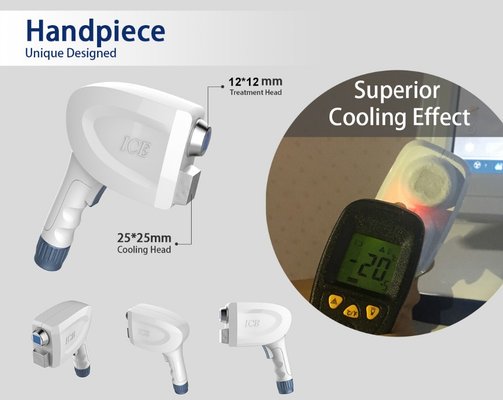
I’ve already written about this at length, but here’s the short version.
Ice cooling — where a sapphire contact tip actively cools to -5°C — isn’t marketing. It changes the patient experience enough to meaningfully affect your business.
Clinics with ice cooling complete 85%+ of treatment plans. Clinics without it complete 55-65%.
That 20-30% gap? That’s patients who quit because of discomfort. Each one represents $300-500 in lost revenue from an incomplete treatment plan. A $400-800 premium for ice cooling pays for itself with roughly two retained patients.
If you can afford it, get the ice cooling. If you absolutely can’t, go with air+water cooling and be prepared to spend more time managing patient comfort expectations.
A Practical Buying Framework
Let me make this concrete. Here are four common scenarios and what I’d actually recommend.
1. You’re starting mobile on a budget.
- Machine: Portable 808nm 600W
- Power: 600W (handles 5-8 home visits/day)
- Cooling: Air + water (acceptable for mobile use)
- Budget: ~$1,500-2,000
- Rationale: Lowest-risk entry. If mobile laser takes off, upgrade within 18 months. If not, you’re not deep in the hole.
2. You’re opening a small fixed-location clinic.
- Machine: 808nm 1200W Desktop with ice cooling
- Power: 1200W (10-12 patients/day)
- Cooling: Sapphire TEC (-5°C)
- Budget: ~$2,500-3,500
- Rationale: The sweet spot. Enough capacity to grow into, ice cooling keeps retention high, and 808nm covers 80%+ of skin types you’ll encounter. This is the machine most clinics should buy.
3. You serve a diverse, mixed-skin-type market.
- Machine: Triple Wavelength 1600W (755+808+1064nm)
- Power: 1600W
- Cooling: Sapphire TEC
- Budget: ~$3,500-5,000
- Rationale: One machine treats everyone. No referring dark-skinned clients elsewhere. No buying a second machine later. The price premium recovers within months through additional patient capture.
4. You run a high-volume chain or premium med spa.
- Machine: 4-Wavelength 3000W Stand
- Power: 3000W (20-25 patients/day)
- Spot: 15×25mm large spot
- Cooling: Quad-cooling system
- Budget: ~$5,000-7,000
- Rationale: Maximum throughput. Largest spot size. Coherent USA bar rated 30 million shots. At 20+ patients/day, this machine pays for itself in under 2 months.
What About the Brands I Keep Hearing About?
Alma. Candela. Cynosure. Lumenis.
These are excellent machines. They’re also priced for the premium Western market — typically $80,000 to $120,000 per unit. Their technology is genuinely good. Their build quality is excellent. Their service networks are reliable.
But here’s what their sales reps won’t volunteer: the core technology inside a $100,000 Alma Soprano and a $3,500 Chinese diode laser is fundamentally the same.
Both use 808nm diode laser bars. Both use sapphire contact cooling. Both target melanin in the hair follicle using selective photothermolysis.
The differences are in finishing, brand prestige, software polish, and regulatory paperwork. Those things matter to some buyers — particularly hospital procurement departments and chain clinics with strict vendor compliance requirements.
For a privately owned clinic, the value proposition of a Chinese factory-direct machine is hard to argue with. Same clinical mechanism. 1/20th the price. Full warranty. CE and FDA certification available.
I’m not saying the premium brands are a bad choice. I’m saying make the choice with your eyes open about what you’re actually paying for.
Red Flags When Shopping
| Red Flag | What It Looks Like | What to Do Instead |
|---|---|---|
| No Real Certification | CE and FDA logos on the website. No actual certificate with company name and model when asked. | Ask: Send me a photo of your certificate with your company name visible. Real suppliers reply within hours. |
| No Manual or Training | Thin PDF that reads like bad Google Translate. No video tutorials. No treatment protocols. | Real manufacturers provide: English manual, setup videos, treatment guide by skin type, direct support access. |
| Stock Photos Only | Every image identical in lighting and angle. Could be from any Alibaba page. | Ask: Photo of the machine with today date on paper next to it. Legit suppliers never hesitate. |
| Pressure to Order Now | Price expires today. Another buyer is waiting. Deposit now to reserve. | B2B sales take 2-4 weeks. No factory ever sold their last machine. Real suppliers are patient. |
| No Spare Parts Policy | Cannot quote cost and lead time for a replacement bar stack or handpiece. | Ask: Exact dollar amount and days to ship a replacement bar stack. If they hesitate, walk. |
A quick list of things that should make you pause:
- No real certification documents. Anyone can put “CE” and “FDA” on a website. Ask to see the actual certificate with the manufacturer name and product model. A legitimate supplier sends these within hours.
- No video call option. If they won’t show you the machine live on a video call, assume they don’t have one to show. Factory-direct suppliers are usually happy to walk you through their production floor.
- Only stock photos. Real manufacturers have real photos of real machines — often with inconsistent lighting, backgrounds, and angles. A site with only polished, identical-looking product shots probably ripped them from somewhere else.
- Pressure to order today. Legitimate suppliers work on 2-4 week sales cycles. Anyone pushing for an immediate deposit is running a sales playbook, not a factory.
- No spare parts policy. Diode laser bars, handpieces, and cooling components eventually need replacement. If the supplier can’t tell you the cost and lead time for a replacement bar stack, walk away.
The Bottom Line
Patient
Volum
| Clinic Size | Patients/Day | Power | Treatment Time | Best Match |
|---|---|---|---|---|
| Small / Startup | 5-8 | 600W | 30-40 min | Portable 600W |
| Established Clinic | 10-15 | 1200-1600W | 20-30 min | 1200W / 1600W Ice |
| High-Volume/Chain | 20+ | 2000-3000W | 12-18 min | 3000W Stand / 4-Wave |
5-8 / 10-15 / 20+
Skin
Types
808nm / Triple / 4-Wave
Brand
Choice
Premium / Direct
Cooling
Choice
Ice / Standard
Your
Machine
Matched to you
Answer four questions — your options narrow from hundreds to two or three.
The best diode laser machine isn’t a brand. It’s not a wattage number. It’s the machine that fits your actual daily reality.
Start with your patient volume. That gives you the power range.
Add your skin-type mix. That tells you single vs multi-wavelength.
Factor in your setup — fixed or mobile. That determines form factor.
Then decide on cooling based on your budget and your commitment to patient comfort.
By the time you’ve answered those four questions, you’ve narrowed the field from hundreds of options to maybe three. At that point, the choice is about supplier trust, warranty terms, and price — not specs.
If you want to talk through your specific situation, get in touch. No pitch. Just a conversation about what makes sense for your clinic.
Written for diodelaserpro.com | Target: Clinic owners and med spa operators purchasing their first or upgrading their diode laser equipment